Vlada · Research · 2026-10-15 · observed
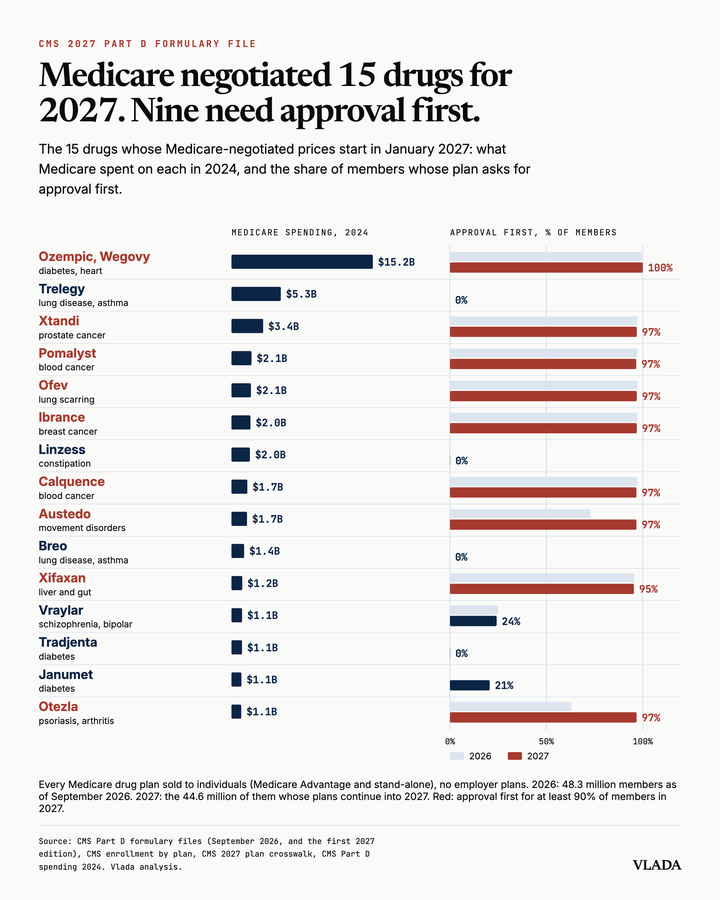
Medicare negotiated 15 drugs for 2027. Nine need approval first.
In the first 2027 Part D formulary file, how do plans cover the 15 drugs whose Medicare-negotiated prices start in 2027, weighted by members?
| The 15 drugs with Medicare-negotiated prices starting January 2027, in every individual Part D plan | 2026 | 2027 |
|---|---|---|
| Ozempic, Wegovydiabetes, heart | 99.4 | 100 |
| Trelegylung disease, asthma | 0 | 0 |
| Xtandiprostate cancer | 97.1 | 96.9 |
| Pomalystblood cancer | 97.1 | 96.6 |
| Ofevlung scarring | 97.1 | 96.9 |
| Ibrancebreast cancer | 97.1 | 96.9 |
| Linzessconstipation | 0.1 | 0.1 |
| Calquenceblood cancer | 97 | 96.7 |
| Austedomovement disorders | 73 | 96.7 |
| Breolung disease, asthma | 0 | 0 |
| Xifaxanliver and gut | 95.6 | 95.4 |
| Vraylarschizophrenia, bipolar | 25 | 24.2 |
| Tradjentadiabetes | 0.1 | 0.1 |
| Janumetdiabetes | 0.1 | 20.6 |
| Otezlapsoriasis, arthritis | 63 | 96.8 |
For each of the 15 drugs (CMS's 2027 negotiated drugs, identified by the formulary file's own SELECTED_DRUG_YN flag in the 2027 edition and grouped by active ingredient as CMS lists them, counting every brand and generic-name listing of that ingredient), the member-weighted share of members whose plan's CMS formulary lists the drug with prior authorization required. Members whose plan does not list the drug count as not needing approval. 2026 = the September 2026 formulary edition weighted by September 2026 plan enrollment; 2027 = the October 2026 edition (first plan-year 2027 formulary) with the same members carried to their 2027 plan by the CMS 2027 crosswalk; the 2027 base is the members whose plans continue (44.6 million of 48.3 million). Spending = CMS Part D gross spending 2024 summed over the drug's brand names. · CMS Monthly Prescription Drug Plan Formulary and Pharmacy Network Information (2026-09 edition; 2026-10 edition 2027_20261008.zip, the first plan year 2027 formulary); CMS monthly enrollment by plan, September 2026; CMS 2027 plan crosswalk; CMS Medicare Part D Spending by Drug 2024; NLM RxNorm (RxNav) for drug names. Vlada analysis. · 15 rows
The posted figure
Read with
- The formulary file shows that prior approval is required, not the criteria, not whether it applies only to new prescriptions, and not how often plans approve. The post says 'approval first', never 'denied'.
- Approval first counts a member when the plan requires prior authorization on at least one listed form of the drug. For 14 of the 15 every listed form carries it; Xifaxan is 95.4% on that basis and 89.3% when every listed strength must carry it (one strength is often listed without).
- The 2027 edition is CMS's first (October 2026); CMS posts corrections monthly and the January 2027 file can differ.
- Members are September 2026 enrollment in individual plans carried into 2027 plans by the CMS crosswalk; employer group plans are not in the public file; new 2027 members and open-enrollment switches are not counted.
- Spending is CMS Part D gross spending in 2024 (before manufacturer rebates), all Part D plans; semaglutide sums Ozempic, Wegovy and Rybelsus; Austedo includes Austedo XR; Janumet includes Janumet XR.
- That the law requires plans to cover negotiated drugs is context, not measured here; the measured fact is that every plan lists all 15 in the 2027 edition.
- No cause is claimed; the data cannot say why plans require approval.
- Seven of the nine already required approval for over 90% of members in 2026 (Ozempic/Wegovy, Xtandi, Pomalyst, Ofev, Ibrance, Calquence, Xifaxan). The 2027 changes are Austedo and Otezla, now listed by every plan, with approval (Austedo listed for 75.9% of members in 2026, 73.0% needing approval; Otezla 65.9% and 63.0%), and Janumet (0.1% to 20.6%, Humana). The post says so and does not claim approval rose because of negotiation.
- 2027 shares are over the 44.6 million members whose plans continue into 2027 (CMS crosswalk). Divided by all 48.3 million September 2026 members instead, each 2027 share is about 7 points lower (e.g. 89.7% rather than 96.9%), because the 3.7 million whose plans end will pick new plans we cannot see yet.
- Linzess (0.1%) and Tradjenta (0.1%) have a sliver of members with approval; the post says 'almost no plan'. Trelegy and Breo are 0.0%. Vraylar (24.2%) and Janumet (20.6%) are partial and are named as such on the figure.
- Drugs are matched by active ingredient across editions, including generic-name listings: a brand-code-only match read Ofev and Pomalyst as listed for 23% and 27% of members in 2026 when the true figure is about 100% (caught by the independent audit).
Ask about this view