Vlada · Research · 2026-10-14 · comparative
Medicare Advantage's shrinking OTC allowance
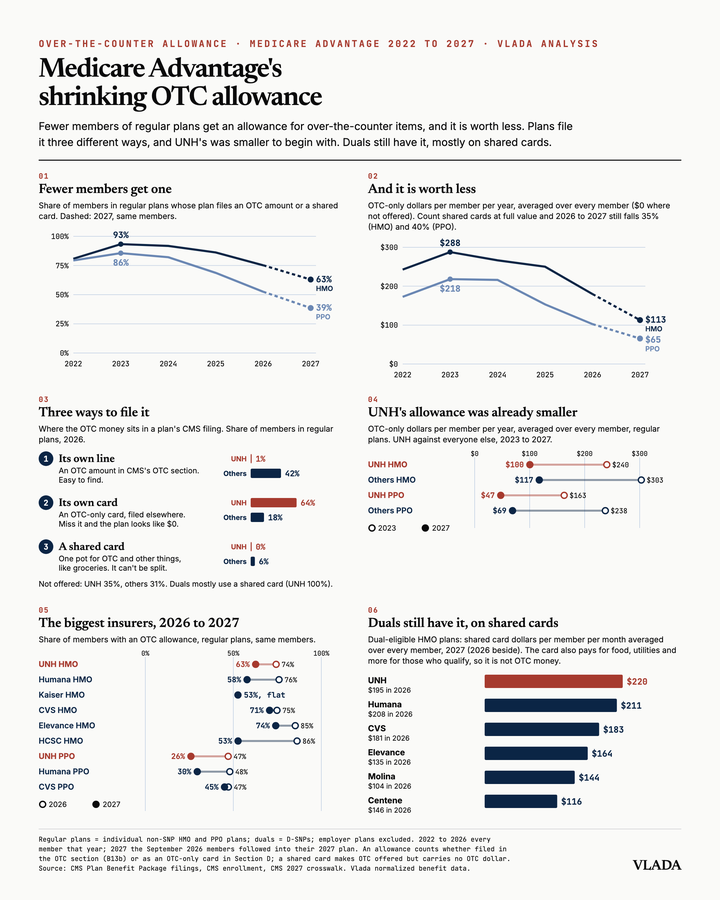
What happened to the over-the-counter allowance across Medicare Advantage from 2022 to 2027, how do plans file it, and how does a normalized read change the answer?
| Individual Medicare Advantage plans, 2022 to 2027 | 2026 | 2027 |
|---|---|---|
| Regular HMO members with OTC2023 to 2027 | 93.3 | 63 |
| Regular PPO members with OTC2023 to 2027 | 85.6 | 38.6 |
| Regular HMO OTC dollars per member per year2023 to 2027 | 287.8 | 113 |
| Regular PPO OTC dollars per member per year2023 to 2027 | 218.3 | 65.4 |
Member-weighted inside one product type. Share = members whose plan files an OTC allowance (in B13b, as an OTC-only Section D card, or inside a pooled card). Dollars = filed OTC allowance per member per year averaged over every member, $0 where not offered and for pooled-card-only members. 2022-2025 December weights, 2026 September; 2027 = the same members followed into their 2027 plan (locked 2027 tables, Edition 1.1). · CMS Plan Benefit Package filings CY2022-CY2027 (sections B13b and D); CMS monthly enrollment by plan and county; CMS 2027 plan crosswalk; Vlada benefit vector v20261007a, vw_pbp_otc, locked 2027 benefit tables Edition 1.1; brochure share from Vlada's Summary of Benefits read (CY2026). · 4 rows
The posted figure
Read with
- Dollars count pooled-card-only members as $0 (about 5% of regular members in 2026); a pooled card's OTC share cannot be separated.
- The duals card pools OTC with food, utilities and other items, and parts may be limited to members who qualify under the chronic-illness rules; it is never stated as OTC money.
- OTC is served but not locked in the benefits lane ledger; the forms used here match brochures 87% (own B13b allowance) and 99% (OTC-only Section D card) of the time.
- This is the filed plan design; it says nothing about use or spending.
- No cause is claimed for the cuts.
- 'Its own line' includes the 2.8% of other insurers' regular members whose plan files an OTC amount in B13b and also has a shared card; 2.7% are offered OTC with no amount filed (not shown as a way).
- Share counts a plan that files an OTC amount (own line or own card) or a shared card. Plans that say OTC is offered but file no amount (3.6% of regular HMO members in 2026, 7.2% in 2022) are not counted, matching the locked 2027 tables (2026 HMO 75.2% here vs 75.5% in the tables).
- 2022 to 2026 count every member that year; 2027 follows the September 2026 members into their 2027 plan (same-member 2026: HMO 75.7%, PPO 55.4%).
- Dollars count only OTC-only money. Counting shared cards at full value (an upper bound, since cards also buy food and other items), same members 2026 to 2027: HMO $264 to $172 (-35%), PPO $149 to $90 (-40%); the decline holds either way.
- Dual-eligible members' own OTC dollars fell (HMO $8.53 to $4.70 per member per month); what grew is the shared card. 'Still have it' refers to the share offered (98.7%).
- Card dollars are averaged over every member, so a rise can mean more members got a card (Molina 63% to 90% of members), not a bigger card.
- The 410K members whose plan files both an OTC-section amount and a shared card count as 'own line' in panels 3 and 4 and as shared-card ($0) in panel 2; the effect is small.
- Panel 5 shows the largest parents by regular membership; Centene's HMOs (67% to 41%, 412K members) also cut sharply.
- Others' 2027 dollars are the market's locked-table value minus UNH's, weighted by continuing members (PPO 6,830,171 minus 1,097,804; HMO 11,798,283 minus 3,009,357).
Ask about this view